
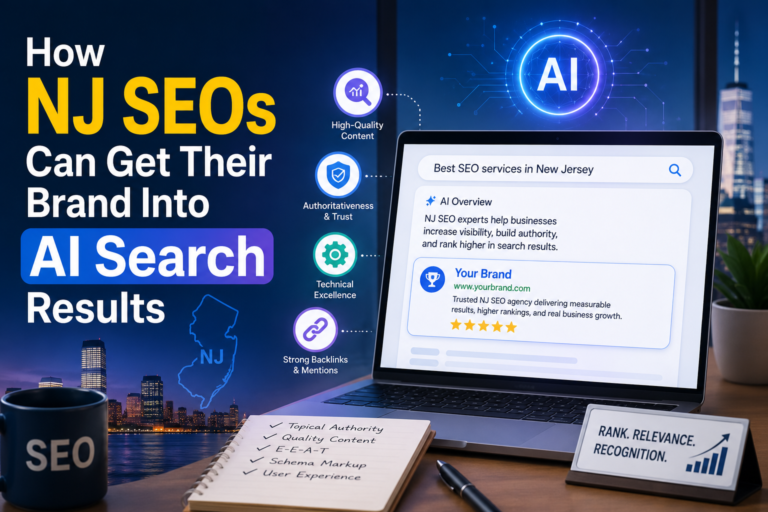
NJ businesses now compete for visibility in two places at once: traditional search results and AI-generated answers on tools like ChatGPT, Google AI Overviews, and Perplexity. Getting cited in these AI answers requires a different approach than ranking a page on Google alone, and it starts with the same foundation as professional SEO services: clear structure, verified facts, and content built around real customer questions. This guide breaks down what NJ business owners need to know to show up when AI tools answer questions about their industry.
A growing share of local searches in New Jersey now start on an AI platform instead of a traditional search bar. A homeowner in Middlesex County asking an AI assistant to recommend a contractor, or a patient in Union County asking which local clinics offer a specific treatment, gets a written answer built from a handful of sources. Businesses that aren’t part of that small pool of sources lose the customer before a website visit ever happens. Understanding how these systems choose their sources is the first step toward staying visible as search behavior continues to shift.
What Is AI Search and Why Does It Matter for NJ Businesses?
AI search tools read multiple web pages, pull out the most relevant facts, and combine them into a single written answer instead of showing a list of links. A person in Rahway searching “best plumber near me” through ChatGPT or Google AI Mode gets one direct answer instead of ten blue links. If a business isn’t part of that answer, it doesn’t matter how well the business ranks on page one of Google, because the customer never scrolls that far. This shift affects every industry represented in New Jersey, from healthcare and legal services to home improvement and manufacturing.
How Is AI Search Different From Traditional Google Rankings?
Traditional Google rankings reward pages that match keywords, earn backlinks, and load fast. AI search tools care about those same fundamentals, but they add another layer: can the answer be pulled out of the page cleanly and trusted as fact? A page can rank on page one and still be skipped by an AI answer if the information is buried in long paragraphs or written without clear structure.
This is where the line between SEO and AEO (Answer Engine Optimization) gets clearer. SEO gets a page into the pool of results an AI tool reads. AEO determines whether that page becomes part of the final answer. Businesses that treat these as one connected strategy, rather than two separate projects, see stronger results across both channels.
It also changes how a marketing team should measure success. Ranking position alone no longer tells the full story, since a page can sit at the top of Google and still be left out of the AI-generated summary above it. Tracking whether a brand actually gets mentioned by name in AI answers, and how often, is quickly becoming as important as tracking keyword rankings. Businesses that only watch their position on the search results page are missing half of what’s happening with their online visibility.

What Signals Do AI Search Engines Use to Choose a Brand?
AI tools weigh a handful of consistent signals before citing a source. They look for direct answers near the top of a page, facts that can be verified across multiple sources, recent publish or update dates, and clear author or business identity. Pages written with vague marketing language rarely get pulled into an answer, because there’s nothing concrete for the AI system to extract and repeat.
This is one of the biggest shifts for NJ business owners who are used to writing content purely for search rankings. Professional SEO services now need to account for both goals at once: ranking well in Google and giving AI tools something specific and factual to cite. A paragraph that reads well to a human but says very little in concrete terms will get skipped by an AI system every time.
How Can NJ Businesses Structure Content for AI Citations?
Structure matters as much as the words on the page. AI tools break pages into smaller sections and pull the piece that answers a question most directly, so a page needs to be organized in a way that makes each section stand on its own.
A few structural habits make a measurable difference:
– Use question-based headings that match how a customer would actually type or ask a question
– Answer the question in the first sentence or two under each heading, then add supporting detail
– Add schema markup (FAQ, HowTo, or Article) so search engines can read the page’s structure automatically
– Break long explanations into short paragraphs or lists instead of one dense block of text
– Keep publish and update dates visible and accurate
None of these changes require rewriting an entire website. Most businesses can apply them page by page, starting with the pages that already bring in the most traffic.
Why Does Local SEO Still Matter for AI Search in New Jersey?
Local relevance still carries significant weight in AI-generated answers, especially for service-based businesses. When someone asks an AI tool for a recommendation “near Woodbridge” or “in Union County,” the system pulls from business listings, reviews, and location-specific content, the same signals that professional SEO services have relied on for years.
Businesses that keep their Google Business Profile updated, gather consistent reviews, and publish location-specific content give AI tools more reasons to connect their brand to local searches. Skipping this step means losing visibility even if the rest of the website is well optimized.
A business with locations or service areas across multiple NJ towns benefits from writing content specific to each area rather than relying on a single generic service page. A roofing company serving Rahway, Linden, and Clark, for example, gives an AI tool far more to work with if each town has its own page addressing local details, permit requirements, or common weather-related issues, compared to one page that mentions all three towns in passing.
What Mistakes Should NJ Businesses Avoid When Optimizing for AI Search?
A few habits consistently hold NJ businesses back from showing up in AI-generated answers. Writing content around broad, generic topics instead of specific customer questions makes it harder for an AI system to match a page to a real query. Publishing pages once and never returning to update them causes even strong content to fall out of rotation as AI tools favor more current sources. And skipping technical basics, like page speed, mobile usability, or clean site structure, can prevent an otherwise well-written page from ever being read by an AI crawler in the first place.
Another common mistake is treating professional SEO services as a one-time project instead of an ongoing process. Search behavior, algorithm updates, and AI citation patterns change often enough that a site optimized a year ago may already be falling behind. Regular audits catch these gaps before they show up as a drop in traffic or visibility.
How Often Should NJ Businesses Update Their Content for AI Search?
AI tools favor recent information, and the sources they cite change more often than traditional Google rankings do. A page that gets pulled into an AI answer this month may be replaced by a competitor’s updated page within a few months if it isn’t refreshed.
This doesn’t mean rewriting content every few weeks. It means reviewing high-value pages on a regular schedule, updating statistics, confirming that service details are still accurate, and adding new information as it becomes available. Businesses that treat their website as a static brochure will fall behind faster than they expect in an AI-driven search environment.
A simple review calendar works well for most small and mid-sized NJ businesses: a quarterly check on the pages that drive the most traffic or leads, and a lighter pass over the rest of the site twice a year. This keeps the most important pages current without turning content updates into a full-time job.
What Role Does Website Structure Play in AI Visibility?
A website’s technical foundation still determines whether AI systems can read it at all. Pages that load slowly, block crawlers, or rely heavily on scripts to display content can be invisible to AI tools even if the writing itself is strong. Clean HTML, fast load times, and mobile-friendly design remain part of the baseline, not an optional extra.
Site architecture matters too. A logical structure of categories, subcategories, and internal links helps both search engines and AI systems understand how pages relate to each other. A service page that’s buried five clicks deep with no internal links pointing to it sends a signal that the content isn’t a priority, even if the information on that page is accurate and well written.
This is where professional SEO services and web design intersect directly. A site built without attention to technical structure can undo months of content work, because the AI system never gets far enough to read the page’s answers in the first place.
How Division Web Design Helps NJ Brands Show Up in AI Search
Division Web Design works with New Jersey businesses to build the kind of site structure, content, and technical foundation that both Google and AI search tools respond to. That work includes keyword research, technical audits, content built around real customer questions, and ongoing updates that keep pages current as search behavior shifts.
Businesses that have relied on the same SEO approach for years often find that a fresh audit uncovers gaps they didn’t know existed, particularly around structured data, page organization, and content freshness. The team also works across industries represented throughout New Jersey, including healthcare, legal services, home services, and manufacturing, adjusting the approach based on how customers in each field typically search and ask questions.
A conversation with the team is a practical next step for any NJ business owner who wants a clear picture of where their site stands today and what it would take to close those gaps. That conversation usually starts with a review of current rankings, a check of whether the brand shows up in AI-generated answers for its most important search terms, and a plan built around the pages most likely to bring in new business.
Final Thoughts
AI search isn’t replacing Google, but it is changing how customers find and choose a business before they ever visit a website. NJ businesses that combine strong technical SEO, clear content structure, and consistent local signals put themselves in a stronger position across both traditional rankings and AI-generated answers. Businesses that continue writing for search engines the way they did five years ago will find it harder to compete as more customers turn to AI tools for recommendations.
The businesses that adapt now, rather than waiting until traffic drops noticeably, will have a head start building the kind of content and site structure that AI systems trust. That head start compounds over time, since AI tools tend to keep citing sources that have already proven reliable, making early action more valuable than a rushed response later.
Getting a website ready for this shift doesn’t have to mean starting over. It starts with an honest look at where a site currently stands, followed by a clear plan built around the pages and searches that matter most to the business. [Reach out to the Division Web Design team](https://division.design/contact-us/) to start that conversation and see where the opportunities are for your business.
